
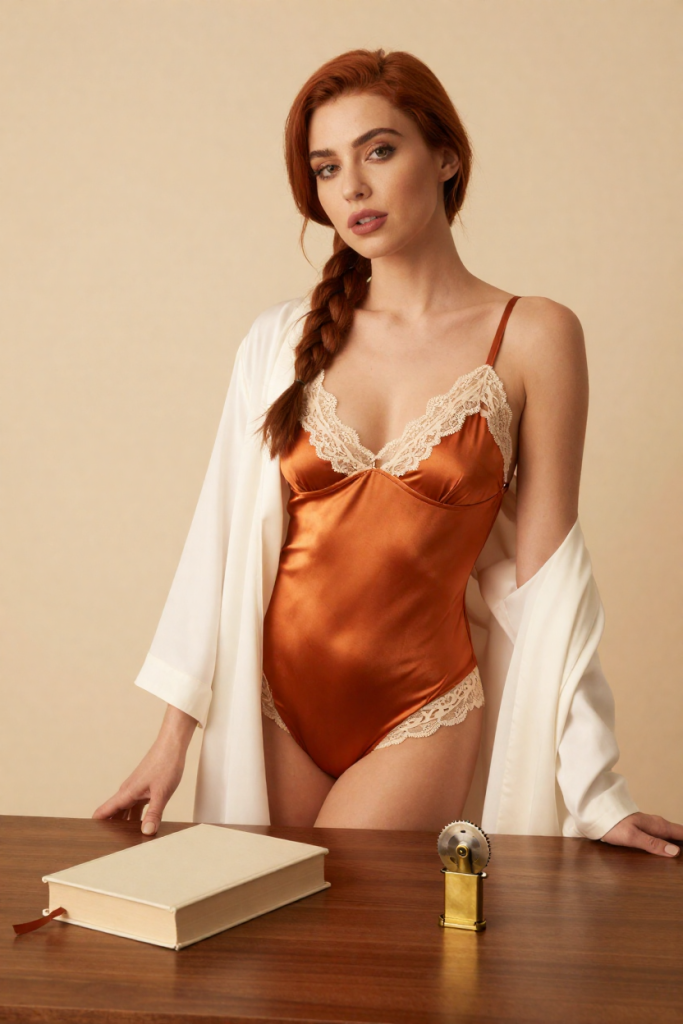
Visitors sometimes ask when the flint wheel gets used. Never — and the never is the point. The wheel is this room’s emblem of repeatability: struck the same way, it would give the same spark, every time, which is exactly what the studio asks of a character card. The moment the wheel became a prop — struck, sparking, theatrical — it would stop meaning that and start meaning a fire effect, which any studio can rent.
An emblem kept cold stays honest
A series, like an emblem, is ruined by improvisation at the symbol level. Change the desk object every sitting and the frames lose their fixed point; the eye has nothing constant to measure drift against. The wheel sits cold on its plain base in frame after frame so that everything allowed to change — outfit, hour, pose — can be seen changing against something that cannot.
The biography beside it
The wheel never appears without the closed biography beside it — cover plain, pages blank of any lettering, ribbon trailing from the spine. The pair is the room’s signature and its method in one image: the book is the life, the wheel is the same-strike promise kept to it. When you brief a frame here, you are setting the fixed point the next twenty frames will be judged against.
Questions
Do I have to include the flint wheel in my frames?
No — it is the house’s own habit, not a rule for members. But some fixed reference of your own, kept constant, will do the same work for your series.
Why is the book always closed?
Because nothing in it is meant to be read. A closed, letter-free cover keeps the frame about the woman and the sitting, never about text.
Why no sparks, ever?
Because an effect is a distraction with a budget. The room spends its drama on the woman, not the furniture.